
9 Dark Academia Home Office Ideas for a Scholarly Space
Last Updated: November 5, 2026
Quick Summary
The best dark academia home office ideas start with a deep, matte colour palette of dark brown, forest green or deep olive, then anchor the room with a walnut desk and dark wood storage. Layer lighting for ambient, task, bias and accent light, and style shelves with real books, brass and one framed oddity.
- Paint walls a deep matte shade first, then let every other decision follow.
- Keep burgundy and gold accents below roughly a fifth of the visible surface.
- Style shelves in threes: a flat book stack, a vertical run of spines, one object.
- Allow at least 60cm of clear floor behind the chair for pushing back.
- Use removable wallpaper, a dark rug and freestanding bookcases for rental-friendly updates.
Table of Contents
- Start With a Moody Dark Academia Colour Palette
- Anchor the Room With a Walnut Desk and Dark Wood Storage
- Dark Academia Desk Decor: Books, Brass and Oddities
- Bookshelves, a Personal Library and Scholarly Wall Art
- Dark Academia Lighting Ideas for Screen Work and Evening Reading
- Dark Academia Small Office Layouts That Actually Work
- Dark Academia Office on a Budget: Reversible, Rental-Friendly Updates
- Build Your Study Around Statement Gothic Pieces
- Frequently Asked Questions
Start With a Moody Dark Academia Colour Palette
The most convincing dark academia home office ideas begin with colour, not furniture. Paint the walls a deep, matte shade first, then let every other decision follow.
A dark academia palette is a narrow set of deep, warm neutrals and jewel tones that make a room feel like an old library reading room. Low-reflectance walls push furniture, books and brass into relief.
Dark Brown, Forest Green and Deep Olive
Pick one dominant shade and two supporting ones. Dark brown, close to bitter chocolate, is the safest base for a small room because it reads warm. Forest green suits a study with a window and garden view.
Test each colour on a wall patch and check it at night under your actual lamp; dark shades shift dramatically once the sun goes.
Where to Put Burgundy and Gold Accents
Burgundy belongs on soft furnishings, not walls: a velvet cushion, a chair seat, a lampshade. Gold accents work best in small, deliberate doses, on a frame edge, a lamp base or a drawer pull.
- Burgundy: seating, curtains, book spines
- Gold: picture frames, hardware, small ornaments
- Keep accents below roughly a fifth of the visible surface
Anchor the Room With a Walnut Desk and Dark Wood Storage
The desk is the piece you will actually touch every day, so buy the best one you can afford. A desk with visible grain gives the room its centre of gravity, and dark wood storage around it carries the eye upward.
Walnut and other dark wood furniture is the backbone of the look. A tall bookcase in the same tone as the desk stops the room feeling pieced together.
Watch out: dark veneer scratches show white.
Dark Academia Desk Decor: Books, Brass and Oddities
Dark academia desk decor works on layers, but the working surface has to survive a real job. Start with the functional layer, then add one or two objects with genuine character.
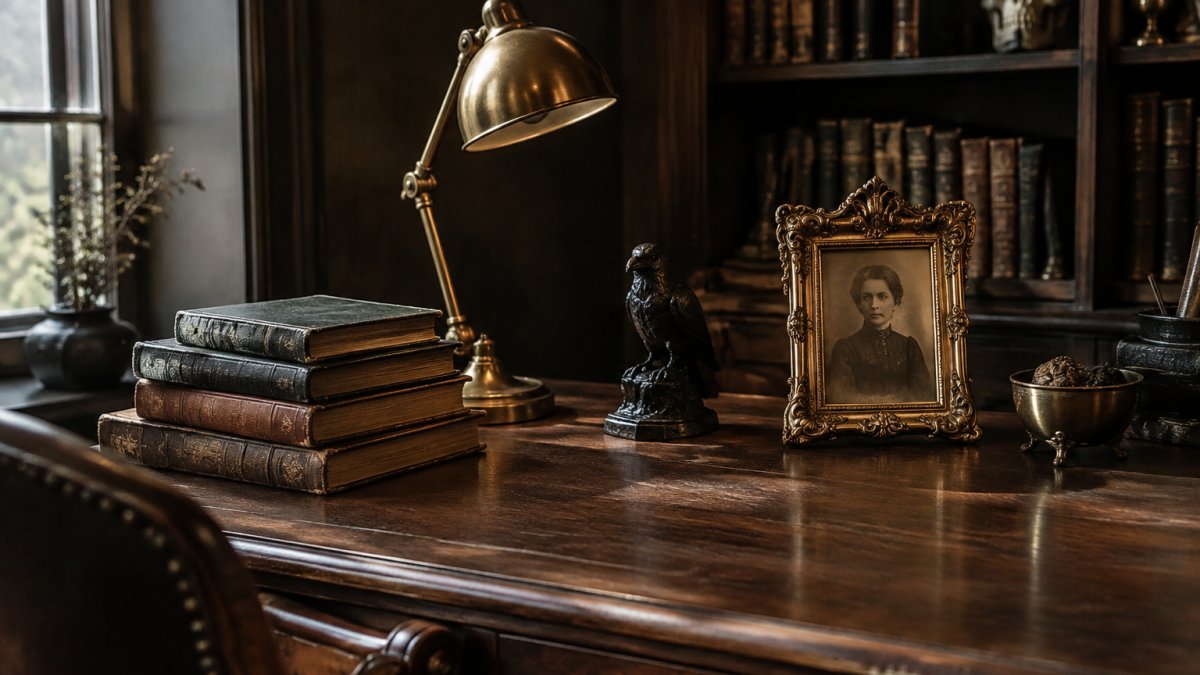
A framed oddity earns its place better than another generic ornament. Our Baphomet occult sepia image in a cast ornate frame is a one-off piece, painted brown with a black wash, and it can stand free or hang. For something smaller and stranger, the framed crow foot claws in a small box frame adds a curiosity shelf feel without eating desk width.

Layered Desk Styling That Still Leaves Room to Work
Keep the centre clear. Push books to one back corner, put the lamp on the other side, and let the ornament sit where your eye lands when you look up. A single Baphomet tea light holder does more for atmosphere than a row of trinkets.

Bookshelves, a Personal Library and Scholarly Wall Art
Bookshelves do the heaviest lifting in any dark academia home office. A tall bookcase styled with real books, a few framed pieces and a small antique object reads as a personal library rather than storage.
Style shelves in threes: a stack of books lying flat, a vertical run of spines, and one object. Leave gaps. A shelf packed edge to edge looks like a warehouse.
For wall art, an ornate frame does most of the work.
Dark Academia Lighting Ideas for Screen Work and Evening Reading
Dark academia lighting ideas usually fail on one point: the room looks glorious at 9pm and unusable at 9am. Stop thinking in lamps and start thinking in layers, each with a job: ambient light for the room, task light for the desk, bias light behind the screen, and accent light for atmosphere. Get the first three right and the fourth can be as moody as you like.
The Four Layers, and What Each One Does
- Ambient: a floor lamp or ceiling fitting that lifts the whole room just enough to stop the walls reading black on camera. Keep it dimmable.
- Task: a desk lamp with a focused beam aimed at your keyboard and papers, not at your face. The beam should fall across the desk at roughly 45 degrees from the side opposite your writing hand, so your own shadow does not cover what you are reading.
- Bias: a soft light behind or beside the monitor, pointing at the wall. This is the single most useful addition for screen work, because it reduces the contrast between a bright screen and a dark room, which is what causes most eye strain in a moody study.
Colour Temperature and Bulbs
Warm light suits the style, but warm light everywhere makes detailed work harder. Pair warmer ambient and accent bulbs with a slightly cooler, higher-output task bulb, so the desk is readable without the room turning clinical. Look for bulbs with a stated colour temperature in kelvin and a high colour-rendering index; a high CRI makes wood grain, book spines and brass look far better than a cheap bulb of the same warmth.
Killing Glare Without Killing the Mood
Glare is the enemy of a dark room with a bright screen. Three fixes, in order of effectiveness:
- Move the desk so the screen is side-on to the window, never facing it or with the window directly behind you.
- Put the task lamp to the side of the monitor rather than in front of it, and shade the bulb so you cannot see it directly from your seated position.
- Use a matte desk surface or a large desk mat; a glossy walnut finish reflects a bright screen straight back at you.
Watch out: a lamp placed behind the monitor to create a cosy glow will silhouette you on video calls and wash the screen with reflected light. Bias light belongs on the wall, not behind your head.
Lighting for Video Calls
If you take calls at the desk, the camera needs a face light the rest of the room does not. A small, warm-white lamp just behind and slightly above the monitor, angled toward you, gives flattering light without flattening the room. Avoid a single overhead fitting directly above your chair, which casts shadows under the eyes. Test once with your camera's preview before committing to where the lamp lives.
Frankenstein & breakfast at tiffany's mash up inspired "made for each other →
Evening Reading
For reading, a narrow-beam lamp over the shoulder beats lighting the whole room. A floor lamp with an adjustable head beside a reading chair, aimed at the page, gives a pool of light that leaves the surrounding shelves in shadow, exactly the effect the style is chasing.
Candlelight is the finishing touch, not the working light. Our deaths head moth tea light holder gives you the flicker without wiring anything in, and the bat candlestick works on a shelf or altar ledge.

- Working light: warm, indirect, behind the screen and on the wall
- Reading light: narrow beam, over the shoulder, opaque shade
- Atmosphere: candles and one low lamp, switched on last
Dark Academia Small Office Layouts That Actually Work
A dark academia small office succeeds or fails on layout, not decoration. Measure the room, mark the desk footprint on the floor with tape, and walk the route from door to chair before buying anything. The style rewards tall, dark furniture, and tall dark furniture in a badly planned room makes a study feel like a cupboard.
Start With the Numbers
Before choosing a layout, note the dimensions that decide what fits:
- Desk footprint: a typical writing desk is around 120cm wide by 60cm deep; a compact one around 100cm by 50cm. Mark the full footprint, including the chair pulled out.
- Chair clearance: allow at least 60cm of clear floor behind the chair for pushing back and standing up, and more if the chair reclines.
- Walkway: keep a clear route of at least 70cm between furniture where you walk, and 90cm where you carry things.
Three Layouts for Tight Rooms
- Desk under the window, bookcase on the opposite wall. Best natural light, but watch screen glare: sit side-on to the glass rather than facing it. Works best in rooms at least 2.4m wide.
- Desk against the long wall, tall bookcase beside the door. Keeps the walking route clear and puts the books within reach of the chair. Suits narrow rooms where a window wall is too shallow for a desk.
- Corner desk with a narrow bookcase at 90 degrees. Creates a nook and hides cables behind the bookcase. Best for rooms under 2m in one dimension, where a full-width desk would block the door.
Ergonomics: Making the Aesthetic Comfortable
The look is period, but your body is not. A few adjustments let a vintage desk work for long sessions:
- Chair: a supportive chair matters more than a beautiful one. If you use an antique or wooden chair, add a firm cushion and check your feet rest flat on the floor or a footrest.
- Monitor height: the top of the screen should sit roughly at eye level when seated upright. A stack of books under the monitor is a period-appropriate riser, but check it is stable.
- Reach: keep keyboard, mouse, notebook and lamp switch within easy reach without stretching or twisting. Ornaments and book stacks belong outside that zone.
Watch out: a deep, ornate desk pushed into a corner can leave you sitting sideways to the screen, which twists the neck over a long day. If the only fit is a corner, angle the desk so you face the room rather than the wall.
Shared and Multi-Use Rooms
Where the study shares space with a spare bed or living area, zone it rather than scatter it. A tall bookcase perpendicular to the wall acts as a room divider and gives the desk a back, making a corner of a larger room read as a study. Keep the desk zone's lighting separate so you can work while the room stays dim, and choose a desk with a modesty panel or fabric screen behind it to hide cables.
Vertical Storage in Small Rooms
Where floor space is tight, go up. A narrow tall bookcase holds more books per square metre of floor than a wide low one, and a shelf above the desk takes reference books and boxes that would otherwise crowd the surface.
These are the measurements the article says to check before buying anything for a small dark academia office.
| Item | Value | Note |
|---|---|---|
| Typical writing desk footprint | Around 120cm wide by 60cm deep | Mark the full footprint including the chair |
| Compact desk footprint | Around 100cm by 50cm | Alternative for tighter rooms |
| Chair clearance | At least 60cm of clear floor behind | More if the chair reclines |
| Walkway | At least 70cm between furniture | 90cm where you carry things |
| Standard tall bookcase depth | Around 30cm | Check it does not crowd the desk chair |
| Door swing | Tape the arc on the floor | The most often forgotten measurement |
| Layout 1 room width | Rooms at least 2.4m wide | Desk under the window, bookcase opposite |
| Layout 3 room size | Rooms under 2m in one dimension | Corner desk with narrow bookcase at 90 degrees |
Dark Academia Office on a Budget: Reversible, Rental-Friendly Updates
A dark academia office on a budget comes down to reversible changes. If you rent, avoid anything you cannot undo in an afternoon.
- Use removable wallpaper or a fabric backdrop instead of paint
- Layer a dark rug over the existing floor
- Add a freestanding bookcase rather than wall-mounted shelving
Charity shops, auction houses and house clearances are where good dark wood and brass turn up cheaply. Check joints and drawer runners before you buy; a wobbly desk is not a bargain at any price.
Build Your Study Around Statement Gothic Pieces
One bold piece gives a dark academia study its personality, and everything else supports it. Choose the statement first, then restrain the rest of the room.
Our dark bat pentagram wall plaque anchors a wall above a desk or reading chair, and the Phul Moon bat ornament and wall decoration is hand-painted resin with a removable stand, so it moves from shelf to wall as your layout changes.
Best for: a study that already has its desk and shelving and needs one focal point.
Skip if: the room is still bare; settle the palette and the desk first.
Frequently Asked Questions
What colours work best in a dark academia office?
Build the room on dark brown, forest green or deep olive walls, then layer burgundy and gold accents on top. Dark brown wood furniture against a green or charcoal wall gives the library feel without making the room cave-like. Keep the ceiling and trim a shade lighter than the walls so the space still reads as a workspace. One warm metallic accent, such as brass on a lamp or frame, is enough to stop the palette feeling flat.
How can I make a small office feel like dark academia?
Use vertical storage and a shallow desk to keep the floor clear. A tall bookcase against the darkest wall draws the eye upward, and floating shelves above the desk add library depth without eating floor space. Choose one moody wall and keep the others lighter so the room does not close in. Position the desk so you face the door or a window rather than a blank wall, and keep the walkway behind your chair at least 80cm clear.
What should I put on a dark academia desk?
Start with the things you actually use: a good task lamp, a pen pot, a notebook and a coaster. Then add two or three decorative pieces, such as a stack of cloth-bound books, an antique-style brass tray or a small framed print. A hand-sculpted framed doll face or a sepia Baphomet print in an ornate frame works as a focal oddity. Leave at least half the desk surface empty so the styling does not crowd out real work.
How do you decorate a dark academia office on a budget?
Paint is the cheapest transformation, and in a rental you can use removable wallpaper or a freestanding screen instead. Charity shops and car boot sales supply old books, brass candlesticks and ornate frames for a few pounds. Group secondhand frames into a gallery wall rather than buying new art. Small statement pieces do the heavy lifting: framed art from The Deviant Angel Emporium starts at £10, so a shelf of curiosities can be built up gradually.
What lighting suits a dark academia workspace?
Layer three sources: a warm task lamp for the desk, a softer floor or table lamp for ambient light, and a candle or two for evening atmosphere. For video calls, put a lamp in front of you rather than behind, or you will silhouette yourself against the dark walls. Aim for warm white bulbs around 2700K to 3000K, and keep the task lamp to the side of your writing hand so it does not cast a shadow over the page.
The hard part is not finding gothic decor, it is choosing pieces that hold a room together instead of crowding it. At The Deviant Angel Emporium we stock hand-painted Alchemy Gothic homewares, framed oddities and statement wall pieces made to sit in a real study, not just a photograph. Browse the homewares collection, pick one anchor piece, and build the rest of the room around it.
