
Gothic Aesthetic Bedroom Design Ideas for 2026
Table of Contents
- Layering Dark and Moody Gothic Interior Design Colour Palettes
- Textural Depth: Velvet, Satin and Lace Canopy Ideas
- Ornate and Vintage Furniture with Victorian-Inspired Accents
- Gothic Bedroom Decor Accessories: Wrought Iron, Candelabra and Wall Art
- Budget-Friendly DIY Gothic Decor and Sustainable Sourcing
- Small Room Gothic Styling: Layout for Functionality
- Conclusion: Your Dark Sanctuary Awaits
- Frequently Asked Questions
Last Updated: September 13, 2026
Layering Dark and Moody Gothic Interior Design Colour Palettes
A gothic aesthetic bedroom begins with colour, and the palette is broader than most people assume. Pure jet black on every surface reads flat and small; the rooms that feel genuinely atmospheric layer charcoal, deep purple, and faded red against a black base. The strongest rooms treat black as a foundation, not a finish. Below, we break down the exact colour combinations and lighting choices that make a dark bedroom feel rich rather than gloomy.
The trick is contrast within darkness. Start with one dominant shade, then add two or three muted tones that sit close to it on the spectrum. Charcoal walls with jet black furniture and burnt orange textiles create depth without brightness. Deep purple bedding against faded red cushions gives the eye somewhere to rest.
Beyond Black: Charcoal, Deep Purple and Burnt Orange
Charcoal is the workhorse of a gothic interior design colour palette. It absorbs light softly, so it never looks as harsh as pure black, and it pairs with almost everything. Deep purple adds a Victorian, slightly decadent note, while burnt orange and faded red bring warmth that stops a dark room feeling cold.
A practical starting formula:
- Walls: charcoal or soft black
- Large furniture: jet black or dark stained wood
- Textiles: deep purple, faded red, or burnt orange
- Accents: gold, brass, or aged silver
Lighting Temperature and Bulb Selection for Rich Colours
Most guides ignore this, and it is the single biggest reason dark rooms look wrong. Cool white bulbs, usually rated around 4000K and above, wash out deep purples and turn charcoal grey (energysavingtrust.org.uk). Choose warm bulbs in the 2200K to 2700K range instead; they make rich colours glow and shadows feel intentional.
For a genuinely moody result, combine a warm main bulb with dimmable lamps and candles. Avoid bright overhead lighting entirely. The Energy Saving Trust guidance on choosing efficient light bulbs is a useful reference for picking warm, low-energy options that still deliver the right tone.
Textural Depth: Velvet, Satin and Lace Canopy Ideas
Texture does more work in a gothic bedroom than colour alone. Velvet, satin, and lace catch light differently, so a room built from a single flat fabric looks dull no matter how good the palette is. Mix at least three textures: a heavy velvet throw, a satin cushion, and a lace canopy over the bed.
A lace canopy is the fastest way to add drama without structural work. Drape black or deep purple lace from a ceiling-mounted hoop or a simple four-poster frame, and let it fall to the floor. Layer a heavier velvet curtain behind it for contrast. Wrought iron bed frames and candelabra-style sconces reinforce the look, while wiry branches or dried stems in a tall vase add an organic, gothic cottagecore edge.
Ornate and Vintage Furniture with Victorian-Inspired Accents
Victorian furniture is the backbone of gothic interior design, and you do not need antiques to get the effect. The key is knowing which Victorian and Gothic Revival signatures actually read as gothic in a bedroom, and which just read as 'old'.
Recognising the Right Era Markers
Not all Victorian furniture is gothic. Look for these specific signals:
- Gothic Revival tracery, pointed arch motifs, quatrefoils, and carved linenfold panels, most common on wardrobes, headboards, and hall chairs
- Turned and barley-twist legs, the spiral leg is a reliable Victorian tell and pairs naturally with wrought iron
- Dark stained hardwoods, mahogany, walnut, and ebonised oak dominate; avoid pale pine, which fights the palette
- Buttoned upholstery, deep-buttoned velvet on a chaise or nursing chair adds instant period weight
- Marble-topped washstands, a Victorian washstand works as a bedside table or altar surface and is still widely available second-hand
A useful rule of thumb: one genuine Gothic Revival piece (a tracery-carved wardrobe, a pointed-arch mirror) does more for the room than three generic 'vintage' items. Build the vignette around that anchor.
Building a Deliberate Vignette
Where most people go wrong is buying one ornate piece and surrounding it with flat, modern furniture. The contrast kills the mood. Instead, cluster three pieces that share a period language:
- A Victorian-inspired dressing table or washstand
- A velvet-upholstered chair with turned legs
- A gold- or brass-framed mirror above
Keep the cluster tight. A vignette works because the pieces visually converse; spread them across the room and each one looks like an orphan.
Sourcing Second-Hand Without Getting Burned
Charity shops, auction houses, and online marketplaces are the main routes, and each has a different risk profile. Before committing to a large vintage purchase, check:
- Woodworm, look for small exit holes and fine dust beneath the piece; active infestation spreads to other furniture
- Loose joints, wobble the piece gently; regluing is cheap, replacing a snapped tenon is not
- Water damage and veneer lift, press the veneer; if it crackles or lifts, restoration costs climb quickly
- Upholstery condition, reupholstering a buttoned chair is skilled work and often exceeds the value of the frame
- Missing hardware, original handles, escutcheons, and castors are hard to replace; a missing set is a bargaining point
A guidance page from the charity regulator on buying second-hand goods safely is worth a read before you commit to a large vintage purchase. If you are buying at auction, remember that buyer's premium and VAT are added to the hammer price, so the final cost is often 20-30% above the figure you bid.
Gothic Bedroom Decor Accessories: Wrought Iron, Candelabra and Wall Art
Accessories are where a gothic aesthetic bedroom becomes personal. Wrought iron, candelabra, and wall art do the heavy lifting, and this is the section where small, well-chosen pieces beat a room full of clutter.
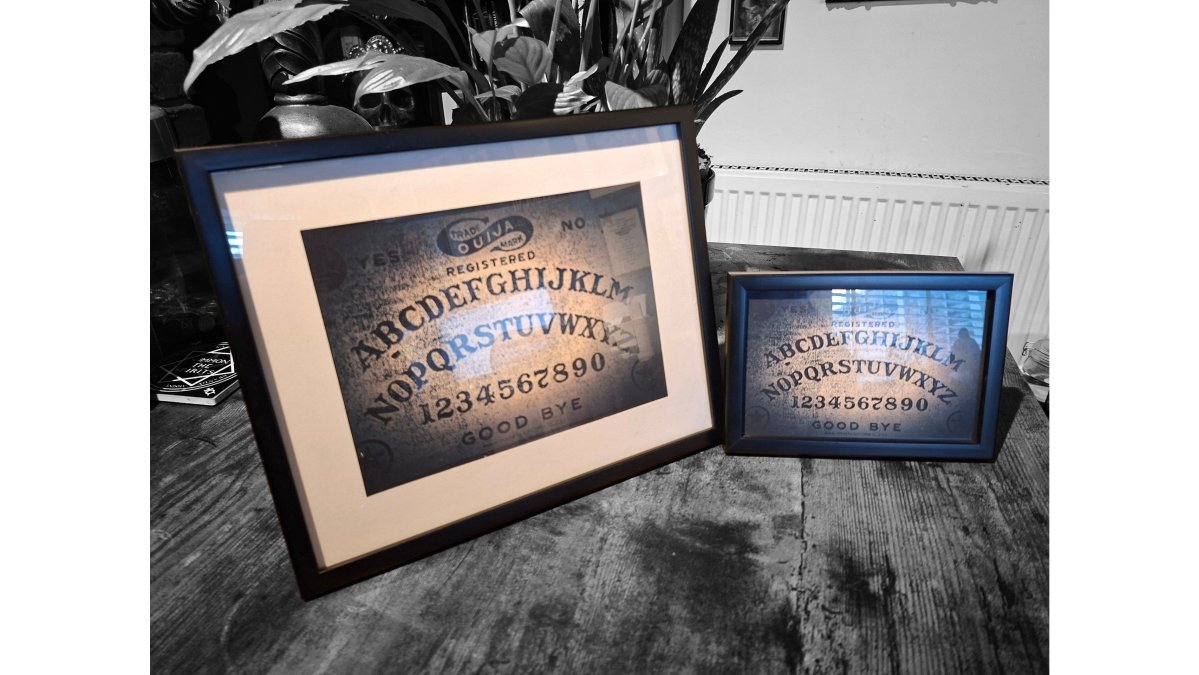
Wall art sets the tone fastest. A framed print works whether you want subtle gothic or full occult. The Deviant Angel Emporium's framed art "Thee Church Of Satan" (£6.50) is freestanding or wall-mounted, so it suits a nightstand display or a gallery wall. For something more paranormal, the Ouija / Spirit Board framed print (£6.50) has an aged sepia finish that sits well against charcoal walls.


Curating Curiosity Cabinets and Occult Alterware
A curiosity cabinet is the collector's answer to a bookshelf. Group oddities on one surface: an apothecary bottle, a framed print, a skull, a candle. The Vampire Blood Apothecary Bottle (£18.00) comes with a bat rosary detail and a deep red fill, and it reads beautifully under warm light. For a genuine centrepiece, the Ram Skull with sculpted Sigil Of Satan (£120.00) is a hand-finished one-off ideal for an altar or curiosity display.

For those worried about sourcing, the Real Bat in Wooden Coffin (£45.00) is ethically sourced and respectfully preserved, presented in a handcrafted coffin display.
Budget-Friendly DIY Gothic Decor and Sustainable Sourcing
You can build a gothic bedroom on a small budget without it looking cheap. The trick is spending where it shows and making the rest yourself.
- Spray-paint second-hand frames matte black instead of buying new ones
- Dye plain cotton curtains charcoal or deep purple
- Print your own art and mount it in an ornate charity-shop frame
- Use dried flowers and wiry branches instead of fresh, which last for years
- Layer charity-shop lace over a plain canopy hoop
Sustainable sourcing matters here, and it aligns with the aesthetic. Second-hand furniture, upcycled frames, and ethically sourced taxidermy all fit a room built on age and atmosphere. When buying bone or taxidermy pieces, always ask the seller how the item was sourced; reputable sellers state it clearly.
Small Room Gothic Styling: Layout for Functionality
A dark, layered room can easily feel cramped, so layout matters more in small spaces. Most gothic bedroom guides are purely visual, they show you the mood but not how to fit it into a room that is, say, 2.5m by 3.5m. This section is about the floor plan, not the mood board.
Start With the Bed Position
In a small room, the bed dictates everything else. Three workable positions, in order of preference:
- Centred on the darkest wall, the classic gothic layout. The bed becomes the focal point, and the canopy draws the eye upward. Requires roughly 60cm clearance on each side for a double.
- Against a side wall with the head under a window, frees the longest wall for a wardrobe and a vignette. Works well when the window is small and you can dress it heavily with velvet curtains.
- Corner placement, the last resort. It saves floor space but kills the symmetry that makes a gothic bedroom feel deliberate. Only use it if the room is under 2.5m wide.
Avoid placing the bed directly opposite the door if you can. It creates a corridor of dead space and makes the room feel like a passage rather than a sanctuary.
The Vertical Rule
In a small gothic bedroom, vertical drama beats horizontal clutter. Every piece of furniture should either be low and wide (a low bed frame, a long low chest) or tall and narrow (a slim wardrobe, a tall mirror, a wall-mounted candelabra). Mid-height, mid-width furniture is what makes small rooms feel stuffed.
A low bed frame with a tall lace canopy does more for a small room than any amount of extra furniture. The canopy takes up zero floor space and adds roughly 1.5m of visual height.
A Worked Layout for a 2.5m × 3.5m Room
Assuming a standard small double (135cm wide) and a door on the short wall:
- Long wall (3.5m): bed centred, 60cm clearance each side, tall lace canopy above
- Short wall opposite the door: slim wardrobe (60cm deep) and a wall-mounted mirror
- Short wall with the door: a single wall-mounted sconce and a narrow console or washstand as a bedside surface
- Under the window: a low chest or blanket box for storage, doubling as a window seat
This leaves a clear walking path of roughly 80cm from door to bed, the minimum for comfortable movement.
Common Small-Room Challenges and Fixes
| Challenge | Fix | Why It Works |
|---|---|---|
| Feels cramped | One statement wall, not four | Dark on one wall only preserves perceived space |
| Blocks walkway | Wall-mounted art and sconces | Frees floor space entirely |
| Too dark to function | Warm dimmable lamps at 2200-2700K | Controls brightness without washing out colour |
| Cluttered surfaces | Vertical curiosity shelves | Displays without spreading across surfaces |
| Bed dominates | Low-profile frame, tall canopy | Draws the eye upward, not outward |
| No storage | Ottoman bed or under-bed boxes in dark fabric | Hides clutter without adding furniture |
Lighting the Small Room
Overhead lighting is the enemy of a small gothic bedroom, it flattens the room and highlights every tight corner. Use three light sources instead: a warm bedside lamp, a wall sconce, and a candle or two. Layer them on separate switches or smart plugs so you can dial the mood up or down without moving.
Conclusion: Your Dark Sanctuary Awaits
Building a gothic bedroom that feels intentional rather than themed takes the right palette, texture, warm lighting, and a few genuinely striking pieces. The difference between a room that works and one that does not usually comes down to layering and restraint.
At The Deviant Angel Emporium, we stock the oddities, framed art, and occult alterware that finish the look, from ethically sourced taxidermy to one-of-a-kind sculpted pieces. Browse our homeware collection and find the statement piece your dark sanctuary is missing.
Frequently Asked Questions
How can I make my bedroom look gothic without painting the walls black?
Focus on gothic bedroom decor accessories and textiles instead. Use charcoal or deep purple bedding, heavy velvet curtains, and ornate mirrors with gold frames. Add a lace canopy or drapery to create a dramatic atmosphere without altering the walls. Wall art featuring vintage posters or occult themes, like a framed Ouija board print, can instantly shift the room's mood. Layering textures such as satin, lace, and wrought iron creates depth and a rich, moody feel that defines the gothic aesthetic.
What lighting choices best complement a gothic aesthetic bedroom design?
Choose soft, warm lighting to enhance rich colours like deep purple, burnt orange, and faded red. Bulbs with a colour temperature between 2200K and 2700K create a candlelit glow that suits the dramatic, atmospheric mood. Avoid cool white or blue-toned bulbs, which flatten the depth of dark walls and velvet fabrics. Wrought iron candelabras, salt lamps, or dimmable Edison bulbs in vintage fixtures work well. Placing lights at different heights, such as a bedside lamp and a low floor uplight, adds layered shadows that define the gothic look.
How do I balance dark gothic decor in a small bedroom?
In a small room, use a dark gothic interior design colour palette on the walls and ceiling to blur boundaries and make the space feel larger. Choose furniture with exposed legs or wall-mounted pieces to keep the floor visible. Mirrors with ornate gold or black frames reflect light and add depth. Keep accessories curated rather than cluttered: one statement taxidermy piece, a small apothecary bottle, and a single framed artwork can carry the theme. Layering a lace canopy over the bed draws the eye upward, adding height without taking up floor space.
What are the essential elements of a gothic bedroom aesthetic?
The core elements include a moody colour palette (jet black, charcoal, deep purple), layered textures (velvet, satin, lace), ornate or vintage furniture, and dramatic lighting. Wall art and decor themes such as skulls, wiry branches, and Victorian-inspired accents complete the look. A lace canopy or heavy drapery adds theatricality. For authenticity, incorporate gothic bedroom decor accessories like wrought iron candelabras, gold mirrors, and curiosity cabinet pieces. These elements together create a rich, atmospheric, and textural space that feels both historic and personal.
The hardest part of a gothic bedroom is not the palette; it is finding pieces that feel authentic rather than mass-produced. The Deviant Angel Emporium specialises in exactly that: handcrafted taxidermy and bone art, framed occult artwork, and niche accessories you will not see in every home. Explore the collection and build a room that is unmistakably yours.