
How to Spot High Quality Jewellery: A Gothic Buyer's Guide
Table of Contents
- Why Most Gothic Jewellery Fails the Quality Test
- The 5-Point Inspection: How to Spot High Quality Jewellery
- Understanding UK Hallmarking Requirements for Authenticity
- Gold Plated vs Gold Vermeil: Know the Difference
-
Spotting Synthetic Stones and Counterfeit Tactics
- The Loupe's-Eye View: What Inclusions Actually Look Like
- The Thermal Conductivity Test: A Practical Field Check
- The Hallmark Forgery Problem: How Modern Fakes Mimic Stamps
- The Acid Test: When and How to Use It
- The Counterfeit Tells That Sellers Hope You Miss
- The Certification Question: What Documents Actually Prove
- A Field Checklist for Stone Verification
- Caring for Gothic Jewellery to Preserve Its Quality
- Ethical Sourcing: A Marker of True Quality
- Your High Quality Jewellery Checklist
- Frequently Asked Questions
Last Updated: September 9, 2026
Why Most Gothic Jewellery Fails the Quality Test
Gothic jewellery occupies a strange corner of the market. Unlike fine jewellery, the alternative scene is flooded with mass-produced pieces that look dramatic in photos but crumble in real life. The difference between a piece that lasts a decade and one that tarnishes within weeks comes down to the materials hidden beneath the dark finish. In this niche, developing a clear eye for how to spot high quality jewellery is essential.
Sellers know you are buying for the look, so they cut corners on the parts you cannot see in a listing photo. Below, we break down a five-point inspection that takes about two minutes, followed by the hallmarking rules that separate genuine precious metal from clever costume pieces.
The 5-Point Inspection: How to Spot High Quality Jewellery
High quality jewellery is identifiable through five physical checks requiring no specialist equipment beyond a jeweler's loupe and your own senses. Perform them in order, because each check narrows the field of suspicion.
Point 1: Weight and Density as a First Signal
Pick the piece up before you look at anything else. High quality jewellery has a satisfying heft because it uses solid metal rather than hollow castings or thin stampings. Compare two similar rings side by side and the weight difference becomes obvious within seconds. If a piece feels hollow or plasticky, put it down.
Sterling silver has a density of approximately 10.5 grams per cubic centimetre, while 9 karat gold is around 11.5 grams (gem-a.com). A simple kitchen scale, accurate to 0.1 grams and available for under £10, can turn this subjective check into a quantitative one. Weigh the piece and compare it to a known genuine item of similar size. If the difference exceeds 20%, something is wrong.
Counterfeiters know buyers check weight, so some hollow pieces are filled with tungsten or lead inserts to mimic the heft of solid precious metal. Tungsten has a density of 19.3 grams per cubic centimetre, nearly double that of silver, so a tungsten-filled piece may feel heavier than genuine solid silver. Weight alone is insufficient; it is a first signal, not a verdict.
Point 2: Hallmarks and Stamps You Can Trust
Turn the piece over and look for stamped marks. High quality jewellery in the UK carries a hallmark, or at minimum a maker's mark and a metal content stamp such as 925 for sterling silver or 375 for 9 karat gold. These stamps are pressed into the metal, not painted on. A common counterfeit tactic is to laser-engrave "925" onto a base metal surface, so check that the stamp has depth and crisp edges. If you see no stamp at all, the piece is almost certainly costume jewellery regardless of the price tag.
Under the Hallmarking Act 1973, any item described as gold, silver, platinum, or palladium must be assayed and hallmarked at one of the four UK assay offices, London, Birmingham, Sheffield, or Edinburgh, before it can be legally sold. The hallmark consists of three compulsory marks: the sponsor's mark, the fineness mark, and the assay office mark. To verify a hallmark, use the online hallmark lookup tool provided by the British Hallmarking Council. A genuine hallmark is struck with a punch, which displaces metal and leaves a slight raised edge around the impression. Under 10x magnification, look for this raised burr. A laser-engraved mark removes metal and has clean, sharp edges with no burr, the single most useful visual cue for spotting fake stamps.
Point 3: Craftsmanship and Finish Under a Loupe
The jeweler's loupe reveals what the naked eye cannot. Examine the surface for tool marks, uneven polishing, or rough edges where the piece was cast. High quality jewellery shows a consistent finish across every surface, including the parts hidden from view when worn. Sloppy casting leaves tiny pits and bubbles that catch the light. A well-made piece has a smooth, continuous surface with no visible seams.
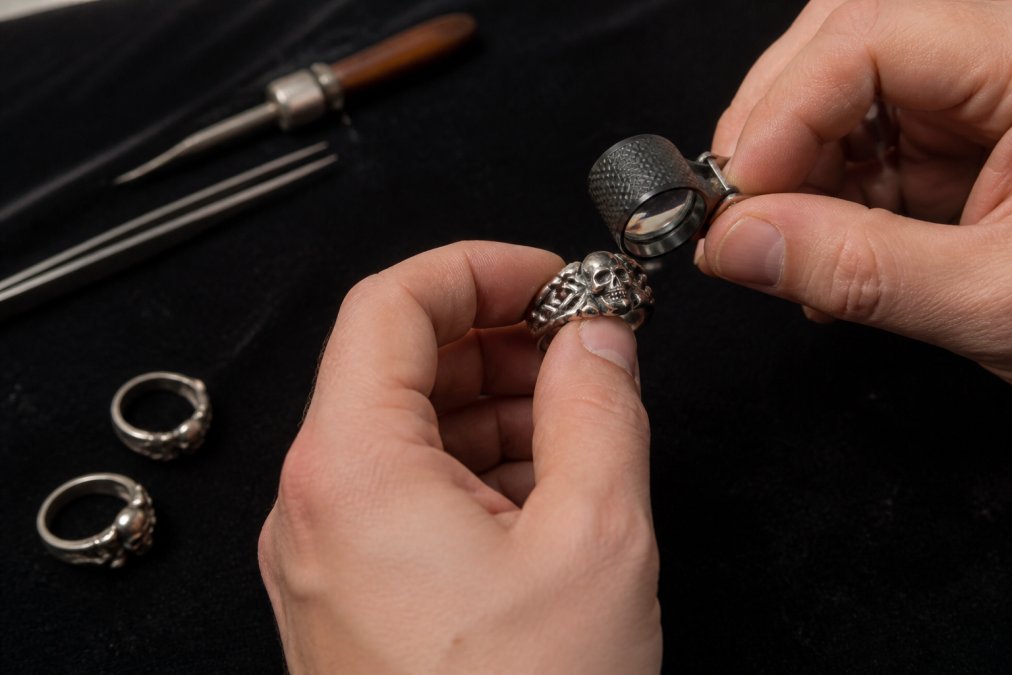
Look for "flash", thin fins of metal where mould halves met, and "porosity", tiny pits caused by gas bubbles trapped during cooling. Both are signs of rushed casting. A quality piece is hand-finished after casting, with all flash removed and porosity polished out. Check the back of the piece as carefully as the front. Many manufacturers polish only the visible surfaces and leave the reverse side rough. High quality jewellery is finished on all sides. The transition between different elements should be seamless, with no visible solder lines or gaps.
Point 4: Gemstone Settings and Prong Tension
If the piece includes gemstones, the setting tells you everything. High quality jewellery uses prongs that grip the stone firmly with visible tension, or a bezel setting that fully surrounds the stone. Check each prong with your loupe. They should be uniform in size and shape, with no gaps between the metal and the stone. Give the piece a gentle shake near your ear. A stone that rattles is a stone that will fall out within months. On cheaper pieces, stones are often glued in rather than set, and that glue degrades with exposure to moisture and body oils.
Press each prong gently with a wooden toothpick. A quality prong will not move. A loose prong will flex slightly, and that flex is the beginning of stone loss. Bezel settings are generally more secure than prongs because they distribute pressure evenly around the entire circumference. However, a poorly made bezel can be too shallow, leaving the stone sitting proud of the rim where it can catch on clothing. The stone should sit level with or slightly below the bezel rim. For glued-in stones, look for a thin line of adhesive around the stone's girdle under magnification. Quality settings never use glue; they rely on mechanical pressure.
Point 5: Clasps, Hinges, and Moving Parts
The clasp is the first thing to fail on any chain or bracelet, so inspect it with suspicion. High quality jewellery uses spring-ring clasps or lobster clasps with a firm, positive action. A weak clasp that feels spongy when pressed will eventually open on its own. For hinged pieces like bangles, check that the hinge moves smoothly without grinding and that the closure aligns perfectly.
To test a clasp, open and close it twenty times in quick succession. A quality clasp will maintain its firm action throughout; a weak clasp will start to feel spongy by the tenth cycle. For chain necklaces, check the link construction. Quality chains use soldered links, where each link is individually soldered closed. Cheap chains are often "cable" chains with unsoldered links that can pull apart under stress. Hold the chain at both ends and apply gentle tension, a quality chain will not stretch or separate. For earrings, check the post and butterfly backing. Quality earrings use posts made from the same metal as the piece, not plated base metal, which will cause skin irritation and wear through quickly.
The Two-Minute Inspection Routine
Once you have internalised these five points, the full inspection takes about two minutes. Start with weight, then hallmarks, then finish under the loupe, then gemstone settings, then clasps and moving parts. The order matters because each check eliminates a category of counterfeit. A piece that passes all five is almost certainly high quality.
Understanding UK Hallmarking Requirements for Authenticity
The UK operates one of the strictest hallmarking systems in the world, and knowing it gives you a powerful authentication tool. Under the Hallmarking Act 1973, any item described as gold, silver, platinum, or palladium must be assayed and hallmarked at one of the four UK assay offices before it can be legally sold. The hallmark includes the sponsor's mark, the fineness mark, and the assay office mark. The official guidance on hallmarking from the British Hallmarking Council explains the full system. If a seller claims a piece is solid silver but it bears no hallmark, that claim is legally questionable. This regulation is the single most reliable way to verify precious metal content, because faking a hallmark is a criminal offence and carries serious penalties.
Gold Plated vs Gold Vermeil: Know the Difference
Gold plated jewellery has a thin layer of gold applied over a base metal, often brass or copper. The plating thickness varies enormously, and cheap pieces may have a layer so thin that it wears through within weeks of daily wear. Gold vermeil, by contrast, is a specific standard: it requires a sterling silver base with a gold layer of at least 2.5 microns. When shopping for gothic pieces, check the product description for the plating thickness. If the seller does not state it, assume the worst. A piece described simply as "gold tone" is almost certainly costume jewellery with no lasting value.
Spotting Synthetic Stones and Counterfeit Tactics
Synthetic gemstones are not inherently low quality. The problem arises when a seller charges natural stone prices for a synthetic product, or when glass is passed off as a gem entirely. High quality jewellery with genuine stones should come with certification, particularly for expensive stones. For gothic pieces, the most common stones are onyx, garnet, amethyst, and various quartz. A quick test with a jeweler's loupe reveals the difference: natural stones contain small inclusions, while synthetic stones often look too perfect. Glass imitations frequently show tiny air bubbles under magnification. Some manufacturers stamp "sterling" on a silver-plated copper base, relying on the buyer never to file the edge. If you are buying a significant piece, a simple acid test kit or a visit to a local jeweller for verification is worth the effort.
The Loupe's-Eye View: What Inclusions Actually Look Like
Natural stones almost always contain inclusions, tiny crystals, feathers, or needles, that formed during their growth deep underground. These are not flaws; they are fingerprints of authenticity. A natural amethyst might show small "fingerprints" of liquid and gas trapped during crystallisation. Natural garnets frequently contain rounded, crystal-like inclusions that look like tiny grains of sand under magnification. Onyx, a cryptocrystalline quartz, often shows subtle, irregular banding that is visible under 10x magnification.
Synthetic stones, by contrast, often look too perfect. A lab-grown corundum may be completely clean under the loupe, with no inclusions at all, this perfection is itself a red flag. More tellingly, synthetic stones produced by the Verneuil flame-fusion process often display curved striations: fine, parallel lines that curve across the surface of the stone. If you see curved growth lines, the stone is almost certainly synthetic. Glass imitations are easier to spot. Under 10x magnification, glass frequently contains tiny, perfectly round air bubbles, a dead giveaway because natural and synthetic gemstones do not form round bubbles.
The Thermal Conductivity Test: A Practical Field Check
For diamond and moissanite, a thermal conductivity tester is a practical field tool. These inexpensive pen-sized devices, available from UK jewellery supply shops for around £15-£25, distinguish diamond from most simulants because diamond conducts heat exceptionally well. Moissanite, however, also conducts heat and will fool a basic tester. To separate moissanite from diamond, you need a tester that also measures electrical conductivity, as moissanite is electrically conductive and diamond is not.
For coloured stones, thermal testing is less useful, but a simple scratch test can help. Real quartz (including amethyst and citrine) has a hardness of 7 on the Mohs scale and will scratch glass, which is about 5.5. Glass imitations will not scratch glass. This is a destructive test, so it should only be performed on an inconspicuous area or with the seller's permission.
The Hallmark Forgery Problem: How Modern Fakes Mimic Stamps
Counterfeiters have become sophisticated. The old tactic of stamping "925" on a copper base is still common, but modern fakes go further. Some manufacturers now laser-engrave hallmarks that mimic the depth and crispness of genuine struck marks. The difference is subtle: a genuine hallmark is struck with a punch, which displaces metal and leaves a slight raised edge around the impression. A laser-engraved mark removes metal, leaving a clean, sharp cut with no raised edge. Under 10x magnification, look for this raised burr around the edges of the stamp.
Another modern tactic is to use a genuine hallmark from a cheap piece and solder it onto a more expensive-looking counterfeit. The solder joint around the hallmark area will be visible under magnification, and the hallmark may not align perfectly with the surrounding surface. If a hallmark looks like it has been applied separately, treat the piece with suspicion.
The Acid Test: When and How to Use It
Acid testing kits are available from UK jewellery suppliers and cost roughly £10-£20. A tiny scratch is made on an inconspicuous area of the piece, and a drop of acid is applied. For silver, the acid should remain a clear or slightly cloudy colour; if it turns green, the piece is silver-plated copper. For gold, the acid colour changes depending on karat. These kits are reliable but destructive to the surface, so they should only be used on pieces you own or with explicit seller permission.
The Counterfeit Tells That Sellers Hope You Miss
Counterfeiters rely on specific psychological shortcuts. They know buyers check weight, so they add tungsten inserts to hollow gold-plated pieces. They know buyers check for stamps, so they laser-engrave convincing marks. They know buyers look for patina, so they apply artificial antiquing that wears off within weeks. The most reliable defence is to buy from a seller who provides assay office certification, accepts returns, and has a physical UK address. If a seller offers a piece at a price significantly below the typical metal value for its stated content and weight, the metal content is mathematically questionable.
The Certification Question: What Documents Actually Prove
In the UK, the most reliable certification is the hallmark itself, which is legal proof of metal content. For gemstones, look for a certificate from a recognised laboratory such as the Gemmological Association of Great Britain (Gem-A) or the International Gemological Institute (IGI). A certificate from an unknown or unverifiable laboratory is worthless. If a seller cannot provide certification for a stone priced above £500, treat the claim of natural origin as unverified.
A Field Checklist for Stone Verification
| Test | What to Look For | Verdict |
|---|---|---|
| 10x loupe inspection | Inclusions, curved striations, round bubbles | Natural stones show inclusions; synthetics show curved lines; glass shows round bubbles |
| Thermal conductivity | Diamond conducts heat; moissanite conducts heat and electricity | Separate diamond from simulants; use dual tester for moissanite |
| Scratch test | Real quartz scratches glass; glass does not | Destructive but definitive for quartz vs glass |
| Hallmark edge inspection | Raised burr around stamp edges | Genuine struck marks have raised edges; laser marks do not |
| Acid test | Reaction colour indicates metal content | Green = silver-plated copper; clear = silver |
| Certification | Recognised laboratory document | Gem-A or IGI certificates are reliable; unknown labs are not |
Caring for Gothic Jewellery to Preserve Its Quality
High quality jewellery lasts only as long as its maintenance routine, and gothic pieces have specific vulnerabilities. The dark finishes that make them distinctive, whether oxidised silver, black rhodium, or antique-effect plating, require different care than bright polished metals. Store each piece separately in a soft pouch or lined box to prevent scratching. Avoid contact with perfume, hairspray, and lotion, which accelerate plating wear. Remove rings and bracelets before washing hands or swimming. For sterling silver pieces, a polishing cloth removes tarnish without stripping the oxidised detailing, but never use liquid silver dips on pieces with an intentional dark patina, as the chemicals will remove the antique finish entirely.
Ethical Sourcing: A Marker of True Quality
Ethical sourcing has become a genuine marker of high quality jewellery, because a producer willing to trace their materials is usually a producer willing to invest in craftsmanship. Many alternative jewellery brands now source recycled precious metals or certified gemstones, and this transparency signals a level of care that mass-market factories do not bother with. When evaluating a piece, look for information about where the metal was sourced and how the stones were obtained. The guidance on responsible sourcing from the Responsible Jewellery Council outlines the industry standards for ethical production. For buyers in the gothic community, who often value authenticity and individuality, knowing that a piece was made without exploitative practices adds genuine value to the purchase. If a seller cannot or will not answer questions about sourcing, treat that silence as a red flag.
Your High Quality Jewellery Checklist
| Check | What to Look For | Red Flag |
|---|---|---|
| Weight | Dense, solid feel in hand | Hollow or suspiciously light |
| Hallmark | Stamped 925, 375, or UK assay marks | No stamp or painted-on marks |
| Finish | Smooth surface, no tool marks | Rough edges, pits, visible seams |
| Gemstones | Firm prongs with tension | Rattling stones or visible glue |
| Clasp | Positive, firm action | Spongy or weak closure |
High quality jewellery rewards patience. The pieces that survive for years, that still look striking after a decade of wear, are the ones that pass these checks before they ever reach your jewellery box. The two minutes of inspection this guide describes will save you from the disappointment of a piece that tarnishes, breaks, or simply looks cheap within months.
Frequently Asked Questions
How can you tell if jewellery is high quality?
Look for proper hallmarks, which indicate the precious metal content, and inspect the craftsmanship. High quality jewellery will feel substantial in weight, have smooth finishes without rough edges, and feature secure settings. Use a jeweler's loupe to check for crisp details and even solder joints. A well-made piece shows consistent polish and secure clasps that align perfectly.
What does the 2:1:1 rule in jewellery mean?
The 2:1:1 rule is a design principle where a statement piece is balanced with two smaller, simpler items. For example, if you wear one bold gothic ring, pair it with one modest necklace and one understated bracelet. This creates visual balance without overwhelming your look. It helps you assess quality too: a true statement piece should hold its own without needing additional heavy accessories.
What are the UK hallmarking requirements for precious metals?
In the UK, the Hallmarking Act 1973 requires any item described as gold, silver, platinum, or palladium to be independently tested and struck with a hallmark. This includes a sponsor's mark, the fineness mark (like 925 for sterling silver), the assay office mark, and the date letter. If a piece is sold as solid silver or gold without these marks, its authenticity is questionable.
What is the difference between gold plated and gold vermeil?
Gold plated jewellery has a thin layer of gold bonded to a base metal, often brass or copper. Gold vermeil also features a gold layer, but the base is always sterling silver and the gold must be at least 2.5 microns thick. Vermeil is more durable and higher quality than standard plating. For ethical and lasting pieces, vermeil is the superior choice.
How can you test the authenticity of gemstones at home?
Start with the fog test: breathe on the stone; if the fog dissipates quickly, it is likely genuine. Real stones feel cool to the touch and have internal inclusions visible under magnification. Check the setting: high quality pieces use secure prongs or bezels, not cheap glue. Synthetic stones often look too perfect, with no natural flaws. When in doubt, seek a certificate from a gemological lab.
Why is the weight of a piece an indicator of quality?
Genuine precious metals like sterling silver and gold are dense, so a quality piece feels heavier than its size suggests. Lightweight jewellery often indicates hollow construction or a base metal core with thin plating. For example, a solid stainless steel gothic ring will have a satisfying heft, whereas a plated version feels flimsy. Trust your hand: if it feels cheap, it likely is.
What are the signs of superior craftsmanship in gothic jewellery?
Look for crisp, well-defined details in motifs like skulls and filigree, with no rough edges or solder marks. High quality pieces feature secure stone settings with even prong tension. The finish should be consistent, whether polished or oxidised, and clasps should snap shut firmly. Check that moving parts, like pendants or jump rings, are sturdy. These details separate quality gothic pieces from costume jewellery.
The gothic aesthetic deserves better than disposable fashion. When you invest in a piece that reflects your identity, it should last as long as the symbolism it carries. At The Deviant Angel Emporium, we curate our collection with these standards in mind, favouring stainless steel statement rings and pieces built to endure daily wear. Explore our range of handpicked gothic jewellery and find pieces that pass the quality test.