
Where to Buy Occult Home Accessories: 2026 UK Guide
Table of Contents
- Where to Buy Occult Home Accessories: The Curated Edit
- What Makes a Great Occult Homeware Retailer?
- Witchy Wall Hangings and Spooky Home Accessories
- Gothic Home Decor UK: Ceramics, Ornaments and Candlesticks
- Witchcore Aesthetic Home Decor Ideas for Your Sacred Dwelling
- Ouija Boards, Tarot Card Decor and Divination Tools
- Soft Furnishings with Gothic Twists and Altar Essentials
- Budget vs. Luxury: Curating Your Alternative Homeware
- Frequently Asked Questions
Last Updated: September 14, 2026
Where to Buy Occult Home Accessories: The Curated Edit
Occult home accessories are decorative objects, altar tools, and soft furnishings that draw on esoteric, gothic, and witchy symbolism to shape a room's atmosphere. This guide from The Deviant Angel Emporium separates a good occult homeware retailer from a drop-shipper with a moody logo, and shows where to buy occult home accessories that will still look right in five years.
Below, we break the market into six categories, from wall hangings to altar essentials, with real prices.
What Makes a Great Occult Homeware Retailer?
A great occult homeware retailer is judged on three things: whether pieces are made to last, whether the symbolism is treated with respect rather than as a novelty, and whether you can see exactly what you are buying before it ships. Detailed photography and honest dimensions matter more here than in mainstream homeware.
Two more signals separate serious shops from the rest: named makers, since pieces designed by established gothic houses carry a known standard for casting, painting, and packaging; and clear shipping and returns terms stated up front, because a 46cm candelabra is not a small parcel.
Witchy Wall Hangings and Spooky Home Accessories
Witchy wall hangings and spooky home accessories do the heavy lifting in a dark interior, because walls set the tone before anyone looks at the furniture. The strongest combine hand-painted detail with a size that reads from across the room.
Two standouts worth knowing:
- Alchemy Gothic Personal Baphomet Hanging Decoration (£15.00) is a noise-making wind chime built around the classic Baphomet motif. It is the cheapest way to add movement and sound to a wall without committing to a large ornament.
- Alchemy Gothic Phul Moon Bat Ornament & Wall Decoration (£32.00) is a hand-painted resin plaque with a removable jet-black stand, so it works freestanding on a shelf or mounted on a wall. At 25cm high it holds a wall on its own.
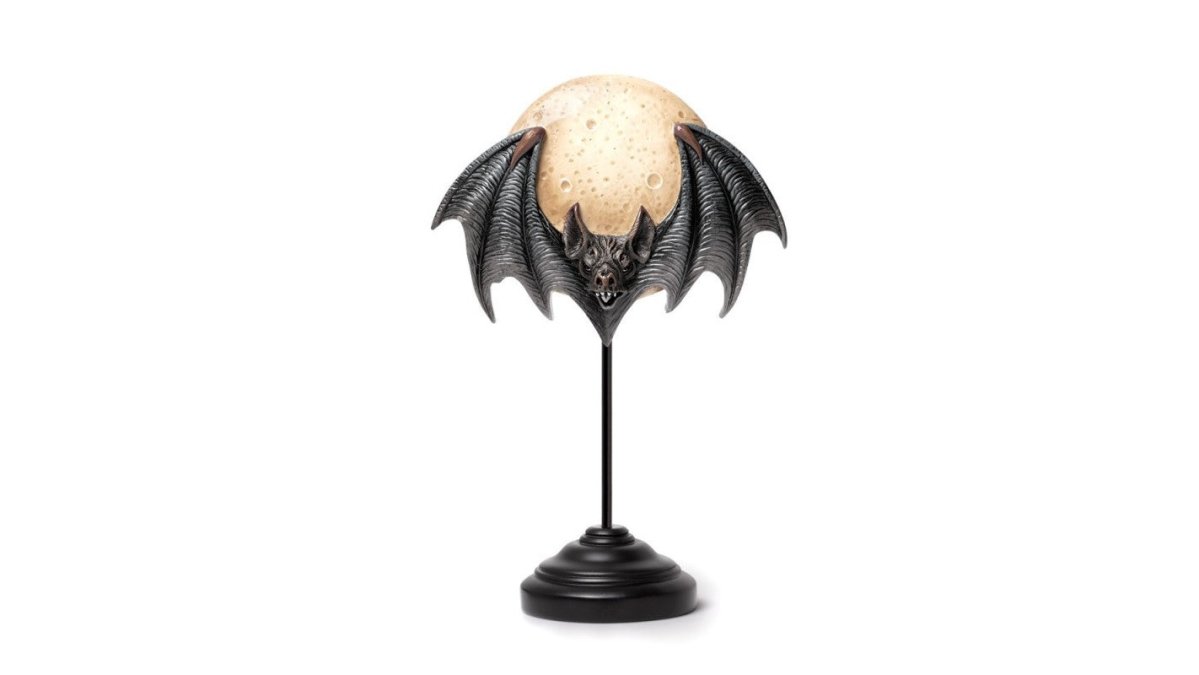
The bat plaque is the better first buy for most people: genuinely hand-painted rather than printed, and the removable stand lets you move it between rooms.


Gothic Home Decor UK: Ceramics, Ornaments and Candlesticks
Gothic home decor in the UK has moved well past the novelty skull. The current standard is sculptural, hand-finished, and heavy enough to feel like a real object, most visible in ceramics, ornaments, and candlesticks.
For a centrepiece, the Nemesis Now White Baphomet Bust (£59.99) is cast in resin and hand-painted by Nemesis Now's in-house design team at 33.5cm tall, the most expensive piece in this guide and the one that anchors a room. For the same symbolism at a lower spend, the Alchemy Gothic Baphomet Ornament & Wall Decoration (£32.00) sets a ram's skull inside a circle of protection with an inverted pentagram at the centre, and works as either a shelf piece or a wall plaque.
The Nemesis Now Baphomet's Radiance Candelabra (£29.99) stands 46cm and arrives with three LED candles, so you get the silhouette without an open flame near fabric. It runs on six AAA batteries.
| Piece | Price | Material | Best Placement |
|---|---|---|---|
| Alchemy Gothic Baphomet Ornament | £32.00 | Hand-painted resin | Shelf or wall |
| Nemesis Now Baphomet's Radiance Candelabra | £29.99 | Resin, LED candles | Mantel or altar |
| Nemesis Now White Baphomet Bust | £59.99 | Hand-painted resin | Centrepiece, console table |
Witchcore Aesthetic Home Decor Ideas for Your Sacred Dwelling
Witchcore aesthetic home decor ideas work best when they follow one rule: group objects by purpose, not by colour. A shelf of apothecary jars, a rack of labelled ingredients, and a single ornament above them reads as a real working space. The same objects scattered across three rooms read as clutter.
Kitchen and pantry pieces carry this aesthetic further than most people expect:
- Alchemy Gothic Curses, Tricks & Spells Storage Jars (£20.00) is a set of three ceramic-lidded jars with a hidden naming joke: Curses for coffee, Tricks for tea, Spells for sugar. Self-adhesive labels are included.
- Alchemy Gothic Witch's Spice Rack (£20.00) holds six original Alchemy jars in a freestanding metal frame, with blank labels so you can name your own ingredients.
- kreepsville 666 Goathead Salt and Pepper Shakers (£24.00) sits a pair of glass shakers on a resin Baphomet sculpture, and is the piece guests always pick up.
The spice rack is the smartest buy of the three: it solves an actual storage problem, looks deliberate on an open shelf, and the blank labels let it grow with your collection.

Ouija Boards, Tarot Card Decor and Divination Tools
Ouija boards, tarot card decor, and divination tools are the most personal category in occult homeware, and the easiest to get wrong. Printed reproductions of spirit boards often look flat and cheap in person, while framed art in an aged finish holds up far better on a wall. It helps to know what you are putting on display, because the symbols carry meaning and guests will ask.
What the symbols actually mean
A spirit board is a set of symbols arranged in a fixed layout. Knowing them turns a decorative print into a talking point:
- The alphabet and numerals 0-9 are the working surface. On a traditional board they are laid out in two arcs so the planchette can travel between letters without crossing the centre.
- Yes, No, and the goodbye or farewell position are the three fixed answers. The farewell mark is traditionally placed at the bottom of the board, and the convention of moving the planchette to it before ending a session is the origin of the phrase "the board is closed".
- The sun and moon sit in opposite corners on most Victorian-style boards, representing the two halves of the day and, by extension, the two halves of a question.
- The planchette is the pointer, usually a heart-shaped or teardrop piece of wood or plastic with a small window. On wall art it is often shown mid-board to suggest movement.
Tarot imagery works the same way. The major arcana are the twenty-two named cards, and the ones most often reproduced as decor are The Moon, The Star, The Sun, Death, and The High Priestess (britannica.com). Each has a settled visual language, The Moon with its two towers and howling dog, The Star with its water-pouring figure, so a print that gets the iconography wrong reads as costume rather than homage.
Choosing between a working board and wall art
There are two distinct products here and they are not interchangeable.
A working board is a flat surface you actually use, usually printed on hardwood, MDF, or stiff card, and sold with a planchette. Look for a board at least 40cm by 30cm, because anything smaller makes the planchette cramped and the session frustrating.
Wall art is the decorative version, and it is what most people actually want in a styled room. The framed art "Ouija / Spirit Board" piece (£6.50) is a stylised spirit board image in an aged sepia finish, available in a large 22cm by 27cm size or a small 12cm by 17cm size. It can stand freestanding or hang, making it the simplest way to introduce divination imagery without dedicating a whole wall to it. The aged finish matters: a clean, high-contrast print looks like a poster, while a sepia wash reads as an antique.
Building a divination corner
Divination decor reads as intentional when the pieces are grouped and lit. One framed board, one incense holder, and a single candle on a dark surface will always beat five unrelated occult prints spread across a room.
The Nemesis Now Baphomet's Scent Incense Holder (£25.00) stands 29.2cm, is cast in resin and hand-painted, and is designed to sit at the centre of an altar or curiosity display. Its height is the point, at just under 30cm it anchors a shelf the way a small trinket cannot.
A practical layout for a divination corner:
- One framed board or tarot print as the focal point, hung at eye level
- One incense holder with a wide base to catch ash
- One candle, ideally LED if fabric is nearby
- A small dish or tray for a deck, even if the deck stays in its box
- A dark cloth or runner under the arrangement to separate it from the shelf
A note on respect and provenance
Spirit boards and tarot imagery sit inside living traditions, and the difference between a respectful piece and a novelty is usually in the details. Reputable sellers describe the artwork, name the designer or house behind it, and avoid jokey packaging. If a listing leans on shock value rather than craft, the piece will date quickly in a styled room.
On sourcing, the UK has clear rules on how animal-derived and vintage items must be described and sold, and reputable sellers will tell you the origin of any bone, horn, or taxidermy element on request. If a listing is vague about provenance, that silence is your answer.
Soft Furnishings with Gothic Twists and Altar Essentials
Soft furnishings with gothic twists and altar essentials are what stop a dark room from feeling like a showroom. Texture does the work: matte resin, aged paper, unglazed ceramic, and heavy fabric all absorb light differently, and mixing them gives a room depth a single finish cannot.
For altar essentials, the practical checklist is short:
- One focal ornament, ideally 25cm or taller so it reads from a distance
- A candle holder with an LED option if you have fabric nearby
- An incense holder with a wide base to catch ash
- Storage for ingredients, labelled so you can find things in low light
- One framed or wall-mounted piece to close the composition
The Alchemy Gothic Personal Baphomet Hanging Decoration (£15.00) also works here as a low-cost finishing touch above an altar, and the Nemesis Now Baphomet's Radiance Candelabra (£29.99) covers the lighting slot without an open flame.
Budget vs. Luxury: Curating Your Alternative Homeware
Alternative homeware splits cleanly into two spending bands, and you do not need the top band to build a room that looks considered. What separates a good room from a cluttered one is not the total spend but the order in which you buy and where each piece sits.
| Band | Price Range | What You Get | Best For |
|---|---|---|---|
| Entry | £6.50 - £25.00 | Framed art, storage jars, spice rack, incense holder, hanging decoration | First pieces, renters, small flats |
| Mid | £29.99 - £32.00 | Hand-painted wall plaques, candelabra | Building a focal point |
| Statement | £59.99 | Large hand-painted bust, 33.5cm | A room that is already styled |
The entry band is where most people should start, and it is not a compromise. A £6.50 framed spirit board and a £20 spice rack will change a kitchen far more than one expensive ornament dropped into an unstyled room. Spend up only once you know which wall is the focal point.
The order to buy in
Most people buy occult homeware backwards: they start with the piece they love most, put it on a shelf, and try to build a room around it. The result is a collection of objects rather than a styled space.
A more reliable sequence, based on how rooms actually come together:
- Choose the focal wall first. This is the wall you see when you walk in. Everything else is arranged in relation to it.
- Buy one mid-band piece for that wall. A hand-painted plaque at £32.00 or a candelabra at £29.99 gives the wall a centre of gravity without committing to a statement spend.
- Add two entry-band pieces that serve a function. Storage jars, a spice rack, or an incense holder. Functional pieces earn their place because they are used, not just looked at.
- Add light last. A candelabra or candle holder changes how every other piece reads, because matte resin and aged paper look completely different under a warm, low light source.
- Only then consider a statement piece. A 33.5cm bust at £59.99 works when there is already a composition for it to sit inside. Dropped into an empty room, it reads as a single expensive object rather than a centrepiece.
A common mistake is buying three large pieces at once. Rooms come together faster when you buy one statement piece and build the smaller objects around it over a few months, because you learn what the space actually needs.
Where the money actually goes
Price in this niche tracks three things: material, finish, and size.
- Material. Cast resin is the standard for ornaments and plaques because it holds fine detail and can be hand-painted. Ceramic is used for jars and kitchenware because it is food-safe and wipes clean. Metal appears in frames, racks, and candelabra arms.
- Finish. A hand-painted finish is the single biggest cost driver. It is also the thing that dates least, because brushwork reads as craft where a printed or airbrushed finish reads as mass production.
- Size. A 46cm candelabra costs more to cast, pack, and ship than a 25cm plaque, and the shipping cost is not trivial. Anything over roughly 40cm should be expected to arrive in a larger parcel with corresponding postage.
Ethical sourcing and artisan spotlights
Almost no product listing tells you where the piece came from. That matters to a lot of buyers in this category, and it is worth asking about directly.
A few things to look for:
- A named designer or in-house design team. Houses that design their own ranges, rather than licensing artwork, can tell you who made a piece and when.
- A stated material, not a vague one. "Hand-painted resin" is a real answer. "High-quality material" is not.
- Origin of any animal-derived element. Bone, horn, feather, and taxidermy elements are all subject to UK rules on how they must be described and sold, and a reputable seller will tell you the origin on request (Animal by-product categories, site approval, hygiene and disposal).
- Packaging that matches the price. A £59.99 hand-painted bust should arrive in a fitted box with moulded protection, not loose in a padded envelope.
If a listing is vague about provenance, that silence is your answer. The same applies to dimensions: a seller who cannot tell you the exact height in centimetres is unlikely to have handled the piece.
Budget vs. luxury: what actually changes
At the entry band you are buying an idea, a symbol, a shape, a mood, executed simply. At the statement band you are buying presence: a piece large and detailed enough to hold a room on its own. The gap is not quality so much as scale and finish time.
So spend in the middle first. A £29.99 to £32.00 piece gives you the hand-painted finish and the size to read from across a room, without the shipping and commitment of a large bust. Once it is in place and you can see how the light falls on it, you will know whether the room wants a statement piece at all, and where it should go.
Frequently Asked Questions
Where can I buy authentic gothic home decor in the UK?
Authentic gothic home decor is best sourced from independent UK retailers that specialise in alternative aesthetics. Look for shops that stock recognised brands like Alchemy Gothic and Nemesis Now, as these ensure quality and authenticity. The Deviant Angel Emporium offers a curated selection of occult home accessories, from Baphomet ornaments to witchy storage jars, all shipped from the UK with tracked delivery.
How do I style occult-inspired accessories in a modern home?
Start with a focal point like a Baphomet bust or a framed Ouija board print, then layer in smaller pieces such as candlesticks, incense holders and storage jars. Keep the colour palette cohesive with blacks, deep purples and metallics. Mix textures like resin, glass and ceramic to add depth. Group items in odd numbers and use soft lighting from LED candles to create a mystical atmosphere without overwhelming the space.
What defines the occult aesthetic in interior design?
The occult aesthetic draws on esoteric symbolism, mystical imagery and dark romanticism. Key elements include divination tools like tarot cards and Ouija boards, ritual objects such as candles and incense holders, and decor featuring pentagrams, moons and bats. The style often overlaps with gothic and witchcore aesthetics, using rich textures, vintage curiosities and handmade pieces to create a sacred, atmospheric space.
Are there independent UK retailers for alternative homeware?
Yes, several independent UK retailers specialise in alternative homeware. The Deviant Angel Emporium is one such destination, offering a curated range of gothic home decor UK shoppers can order online. They stock exclusive Alchemy Gothic and Nemesis Now pieces, plus taxidermy and bone art. Independent shops often provide more unique, handcrafted items than mainstream retailers, with detailed product photos and UK-based shipping.
How can I tell if taxidermy and bone art are ethically sourced?
Ethical sourcing for taxidermy and bone art means the animals were not killed for the purpose of decoration. Reputable sellers provide clear information about provenance, often sourcing from natural deaths, roadkill or sustainable populations. Always ask the retailer directly about their sourcing policy. The Deviant Angel Emporium prioritises transparency and offers unique pieces that align with ethical collecting practices.