
9 Witchcore Colour Palettes That Work in Small Apartments
Quick Summary
The best witchcore colour palettes for small apartments balance dark moody tones with light neutrals so the room keeps its atmosphere without shrinking. Start with bone white, ash grey and black lace, or forest green with ivory and antique brass, keeping dark shades to accent areas.
- Keep walls and ceiling light or mid-toned, and bring darker shades in through textiles, frames and objects.
- Use black sparingly, around 10% of the room, so the space reads elegant rather than heavy.
- For the aubergine palette, keep proportions near 60% light neutral, 30% aubergine and 10% pink and mauve.
- Pair aubergine with a warm bulb around 2700K and add a low-level second light source.
- Test paint swatches or fabric samples for a few days, checking them in morning and evening light.
Table of Contents
- Why Colour Matters More in a Small Apartment
- Palette 1: Bone White, Ash Grey and Black Lace
- Palette 2: Forest Green, Ivory and Antique Brass
- Palette 3: Aubergine, Dusty Pink and Smoky Mauve
- Palette 4: Deep Oxblood, Warm Beige and Candlelight Gold
- Palette 5: Slate Blue, Moss and Raw Umber
- Renter-Friendly Witchcore Decor Without Painting
- Choosing Your Palette and Where to Start
- Frequently Asked Questions
9 Witchcore Colour Palettes That Work in Small Apartments
Last Updated: November 7, 2026
Why Colour Matters More in a Small Apartment
Small apartments need colour choices that do more work. The best witchcore colour palettes for small apartments create depth and atmosphere without making a compact room feel like a cave. The trick is balance: dark tones give the cocooning mood witchcore is known for, while lighter accents keep the space from closing in.
A common question is whether you can go dark in a tiny flat without regretting it. For broader witchcore home decor inspiration beyond colour alone, see this witchcore home decor guide. Yes, but the palette has to be planned. In a larger house, a dark wall can sit quietly in a corner. In a studio or one-bedroom, every surface is visible from every angle, so each colour choice carries more weight.
Light neutrals help a room feel larger, and that principle still applies here. A useful rule is to keep the walls and ceiling light or mid-toned, then bring in the moodier shades through textiles, frames and objects. That way you keep the witchy atmosphere while preserving a sense of space.
Colour also changes with the light you have. North-facing rooms receive cooler, flatter light, so warm tones such as oxblood and candlelight gold will feel richer there. South-facing rooms get strong direct sun, which can make deep greens and aubergine glow. Test every paint sample at different times of day before committing.
Palette 1: Bone White, Ash Grey and Black Lace
This is the most forgiving starting point for a first witchcore room. Bone white on the walls, ash grey on textiles and a touch of black lace detailing gives you a gothic look that still feels bright.
- Bone white: walls and ceiling, to reflect available light
- Ash grey: rugs, cushions and curtains, adding softness and depth
- Black lace: small accents such as a throw, table runner or window trim
Use black sparingly, roughly 10% of the room, so the space reads as elegant rather than heavy. A framed doll face piece, such as the Unique hand sculpted Oddity curiosity goth gothic witchy creepy horror "Framed distressed Doll face" wall hanging art, dirty pink finish at £12.50, adds a pop of character against this neutral base.
Palette 2: Forest Green, Ivory and Antique Brass
Forest green is one of the most natural witchcore colours, and it works well in small rooms when paired with ivory. Ivory keeps the green from feeling too dark, while antique brass brings warmth and a sense of old-world craft.
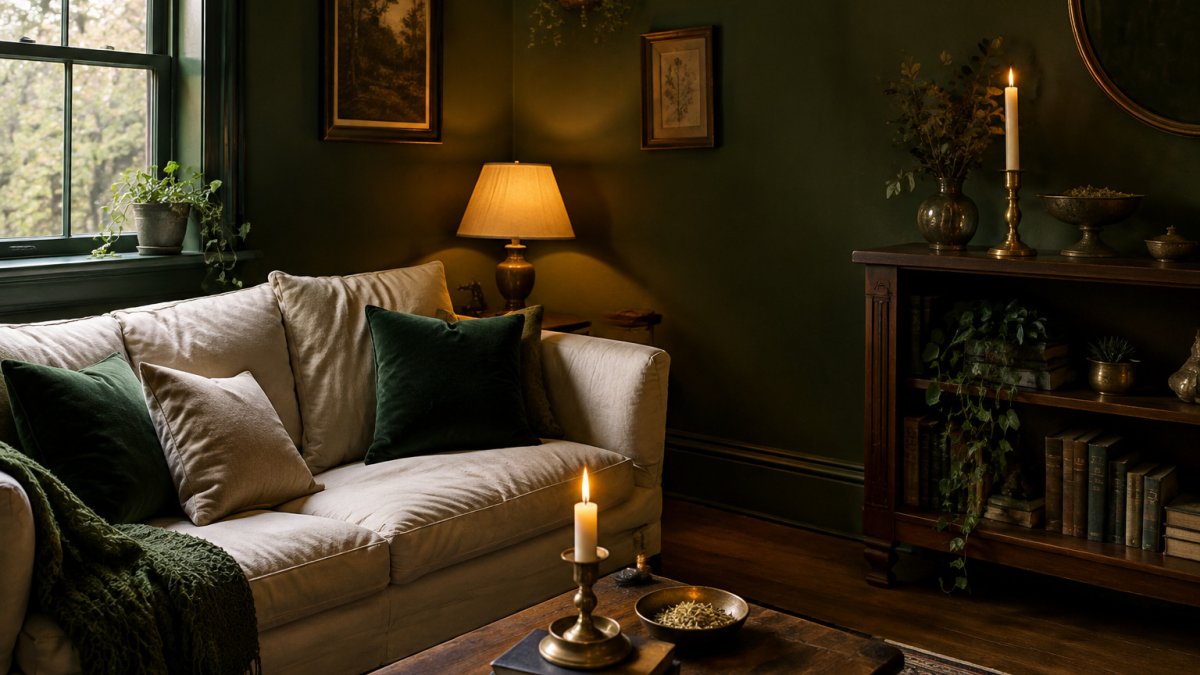
Start with forest green on one accent wall, ideally the wall behind the bed or sofa, rather than covering the whole room. Use ivory linen for upholstery and bedding, then add brass candle holders and small brass objects for shine.
For a sculpted touch, the Unique hand sculpted Oddity curiosity goth gothic witchy creepy horror "Framed distressed Doll face" wall hanging art, green finish at £12.50 suits this palette. A plant pot also reinforces the look: the Alchemy Gothic Water Don't Torture Plant Pot at £13.00 is one way to bring the green indoors.


Palette 3: Aubergine, Dusty Pink and Smoky Mauve
This palette leans romantic and moody, and it is the one most likely to go wrong in a compact room because aubergine absorbs light quickly. The fix is to assign every colour a fixed job rather than scattering them. Treat aubergine as the anchor, dusty pink as the softener, and smoky mauve as the bridge, then keep the proportions roughly 60% light neutral, 30% aubergine, and 10% pink and mauve combined.
A complete recipe for a small bedroom or reading corner:
- Walls: a warm off-white or pale greige on three walls, with aubergine on the wall behind the bed or the chimney breast only. If you want the cocooning effect, paint the ceiling in the same off-white rather than white, so the aubergine does not fight a cold ceiling.
- Trim and woodwork: soft smoky mauve on skirting and door frames rather than bright white. This low-contrast approach stops the dark wall from looking like a floating panel in a small room.
- Ceiling: keep it light and matte. A gloss ceiling in a small room bounces light but can look clinical against aubergine.
- Textiles: dusty pink on cushions, a lampshade, or a single throw. Avoid pink bedding and pink curtains together, which fragments the palette.
- Accents: smoky mauve on vases, book spines, and a small frame or two. Antique brass or aged pewter candle holders sit naturally between aubergine and pink.
For paint matching, ask a mixer to match a deep aubergine, a dusty pink close to a muted rose, and a smoky mauve that reads grey-purple rather than lilac. Test all three on the same wall because aubergine shifts dramatically between daylight and evening.
Lighting does most of the work here. Aubergine absorbs light, so pair it with a warm bulb around 2700K rather than a cool white one, and add a second light source at low level, such as a table lamp or a candle cluster, so the dark wall reads as depth rather than a void. In a north-facing room the aubergine will look almost black by mid-afternoon; in a south-facing room it will glow plum for a few hours and then cool down.
Watch out: painting all four walls aubergine in a studio under 30 square metres usually makes the room feel smaller within a week, because every surface reflects the same dark tone and the eye has no resting point. Keep at least one long wall light and use a mirror opposite the dark wall to borrow light back into the room.
The three shades in this palette need fixed roles and rough proportions to avoid making a compact room feel smaller.
| Colour | Role in the room | Notes |
|---|---|---|
| Aubergine | Anchor | Behind bed or chimney breast only |
| Dusty pink | Softener | Cushions, lampshade or one throw |
| Smoky mauve | Bridge | Trim, vases, book spines |
| Off-white or greige | Base | About 60% of the room |
| Warm bulb | Lighting | Around 2700K |
Palette 4: Deep Oxblood, Warm Beige and Candlelight Gold
Oxblood is the boldest colour in this guide, so it needs restraint. In a small apartment, use it on a single surface such as a door, a bookshelf or a headboard. Warm beige on the other walls keeps the room from feeling enclosed, and candlelight gold adds a glow that reads as deliberate rather than accidental.
Candlelight gold works best in small amounts: candle holders, picture frames or a mirror edge. Together, these three colours create a cosy, almost tavern-like atmosphere that suits witchy living rooms.
Palette 5: Slate Blue, Moss and Raw Umber
Slate blue is a cool, grounding choice. Pair it with moss green and raw umber, a natural earthy brown, for a palette that feels like an old forest cottage. This combination is well suited to rooms that receive plenty of natural light, since the cooler tones can feel flat in dim corners.
Use slate blue for wall colour or large upholstery, moss for plants and cushions, and raw umber for wooden furniture and natural fibres. Raw umber also pairs well with the framed doll face pieces mentioned earlier.
Renter-Friendly Witchcore Decor Without Painting
Many witchcore colour guides assume you can paint, so this section covers renter-friendly options. A witchcore palette can be built entirely from removable pieces, but the trick is to treat each palette as a set of colour roles rather than a shopping list, so the room still reads as coordinated when nothing is permanent.
Walls without paint. Removable wallpaper is the closest substitute for a painted feature wall, and it works best on one wall behind the bed or sofa rather than across a whole studio. Peel-and-stick panels in a deep forest green, aubergine, or slate blue can carry the anchor colour, while the other walls stay in the landlord's existing neutral.
Textiles as the main colour carrier. In a rental, fabric does the job paint would do. A floor-length curtain in forest green or slate blue reads as a coloured wall when drawn, and a large rug in warm beige or raw umber grounds the palette without touching the floor.
Ceilings and light. You cannot usually change a ceiling, but you can change what it reflects. A warm bulb around 2700K in a paper or fabric shade casts a softer, more amber light than a bare cool-white fitting, and a plug-in wall light or a battery candle cluster adds low-level glow without an electrician. In a north-facing rental, this is often the difference between a palette looking muddy and looking deliberate.
Hanging pieces and freestanding decor. Wall decoration, such as the Alchemy Gothic Phul Moon Bat - Ornament & Wall Decoration at £32.00, adds a focal point, and freestanding ornaments and plant pots can be moved between rooms as the palette changes. Keep the number of small objects low in a compact room, because clutter reads faster against a dark palette than against a light one.

Room-by-room application. In a studio, use one anchor colour on the textiles and keep the walls light so the sleeping and living zones do not fragment. In a bedroom, put the anchor colour on the curtains and the headboard rather than the walls. In an entryway, a single dark runner and a warm lamp are enough to set the tone before the rest of the flat.
Watch out: removable wallpaper and adhesive hooks can fail on textured, freshly painted, or damp walls, so photograph the wall before and after and keep the offcuts.
Choosing Your Palette and Where to Start
Begin with the palette that matches your existing furniture. If your sofa is already a neutral, Palette 1 or Palette 2 will be easiest to layer. Test paint swatches or hang fabric samples on the wall for a few days before deciding. Check the colour in morning and evening light, since small rooms can shift dramatically.
For ideas on where to find the pieces that complete a witchcore room, our witchcore aesthetic home decor ideas guide covers broader styling inspiration beyond colour alone.
Frequently Asked Questions
What colours make a small apartment look bigger?
Light, warm neutrals such as bone white, warm ivory and soft greige reflect more of the available light, which helps walls recede and makes a room feel more open. In a witchcore scheme, you can keep that effect by using a pale ceiling and pale woodwork, then adding darker accents on one wall or in textiles. Avoid painting every surface dark unless the room gets plenty of daylight.
Can you use dark colours in a small room?
Yes, but treat them as a deliberate choice rather than a default. Deep greens, aubergine and oxblood create a cocooning effect that many people find cosy, particularly in a bedroom or reading corner. In a small flat, limit the dark shade to one or two walls, keep the ceiling light, and use mirrors and pale furniture to stop the room feeling closed in.
How can you add witchcore style to a rented flat without painting?
Use removable options: peel-and-stick wallpaper panels, lightweight hanging textiles, wall-mounted shelves that fix with picture hooks, and freestanding objects such as the Alchemy Gothic Phul Moon Bat ornament at £32.00, which stands on a removable jet black stand and needs no tools to assemble. Check your tenancy agreement before fixing anything to the wall, and keep the receipts for any items you buy in case you need to show your landlord.
Which paint colours work well in a small, low-light room?
Rooms with little natural light suit warm, mid-tone shades rather than near-black. Warm beige, soft oxblood and muted moss green hold their colour in dim light and avoid the flat, grey look that cool dark paints can create at night. Test a sample pot on the wall at different times of day before committing, as north-facing rooms shift considerably between morning and evening.
